Manuscript entitled, "Fossil Flora and Fauna of the Pennsylvanian Period, Will County, Illinois"
by George Langford (1876-1964)
Return to georgesbasement

George Langford And His Fossils, [An Appendix] by Sydne Holmes

To view any of these images at high resolution (300 dots per inch instead of 100 as on the full-page images) right-click on the image and select view image - GL,III, ed.
Neuropteria, a tree fern, positive impression, GL photograph
Neuropteria = Tree Fern, positive
Neuroptercarpus seed, GL photographs
Neuroptercarpus, both halves
Positive
Negative
Unusually fine insect:

Tenopteron mirable - mirabile - GL photographs
Tenopteron mirable [mirabile - GL,III]
Acanthotelson eilikia, GL photographs
Acanthotelson eilikia. [probably ilikia - GL,III]
Marine creature with a counterpart, Anaspiedes, living today in the sea around Tasmania.

And an unknown insect, too new for a name:
Unknown insect, GL photograph
Two Scorpions:
Gerulina gigantea, GL photograph
Gerulina gigantea.
Lepidoderma, GL photograph
Lepidoderma - marine.
Once they were nine feet long.
They disappeared after the Carboniferous era.

A tiny ganoid fish, 1-1/2 times actual size.
Elonichtys, GL photograph
Tree bark:
Lepidophloios langfordi, GL photograph
Lepidophloios langfordi.
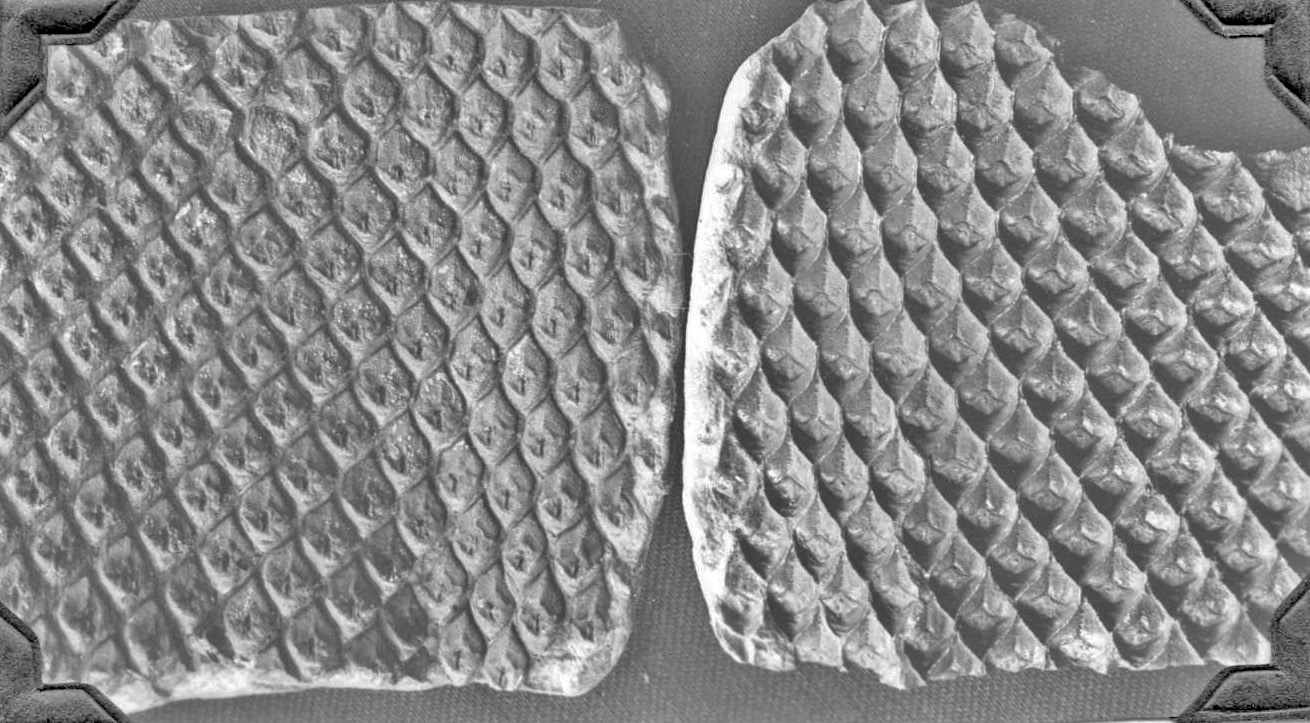
Lepidodendron, positive (left) and negative (right), GL photograph
Lepidodendron
Positive
Negative
Lepidophloios - negative (left) and positive (right), GL photograph
Lepidophloios
Negative
Positive

Seed Case.
Calamite tree cone - Calamostachys, GL photograph
Calamite tree cone Calamostachys, GL sketch
Calamite tree cone.
Calamostachys
Annularia - Calamite foliage
Annularia - Calamite tree foliage
Specimen is 12 inches long. 
It is much like today's bamboo.


Three magnificent spiders:

Curclulioides wilmingtoni, GL photographs
Curculioides wilmingtoni. Holotype
Ootarbus, GL photograph
Ootarbus [he's the one on the right - GL,III]
It's rare to find a spider like this next to a tree fossil.
Pleophrynus ensifer. Holotype. GL photograph
Pleophrynus ensifer. Holotype.
The back of this spider is ridged and marked like tortoise-shell.
Continued